
Book a technical briefing
volumez % ai -foundation

Volumez - AI Data Platform

Software defined storage foundation for high-performance data workloads, enterprise AI and agents infra delivering native GPU Direct, shared KV-cache acceleration, inline ingestion and in-place processing on a single copy of your data.
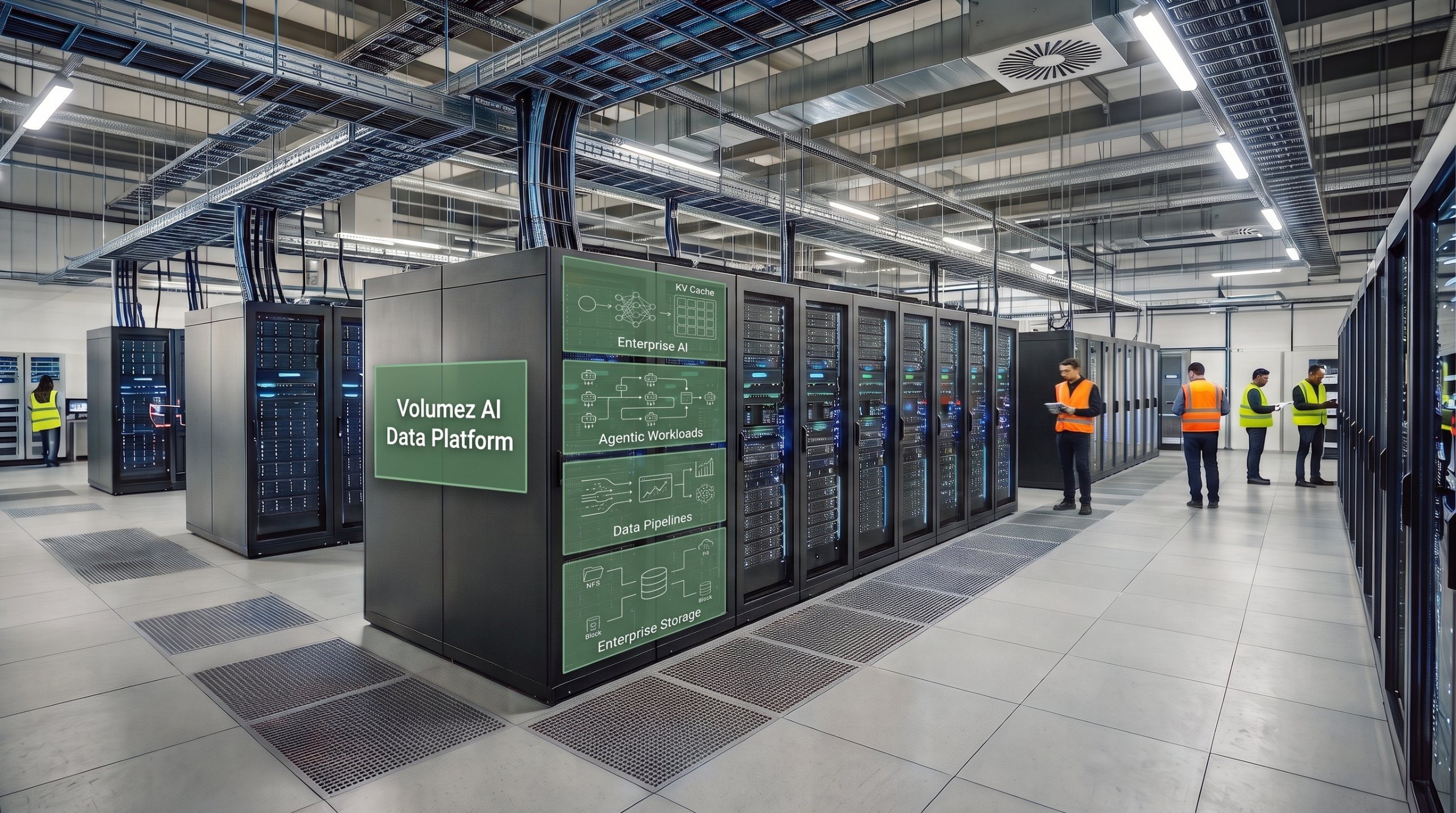
A bright data hall. The nearest cabinet carries a green Volumez AI Data Platform sign, and the rack face beside it shows four green panels – Enterprise AI with a neural network feeding a KV cache, Agentic Workloads as a graph of agents calling tools, Data Pipelines as a flow into charts, and Enterprise Storage with NFS and block paths into disk. Engineers in high-visibility vests work along the aisle.
built for

Enterprises

Defense · Finance · Logistics

GPU Clouds

Neoclouds

AI Inference Providers

Token-serving at scale

SaaS & ISVs with own AI

Product-embedded models

Sovereign AI Clouds

National · Regulated
the problem

Every bottleneck ends the same way

More Compute
More Racks
More Power
More Licenses
More Copies

Organizations keep optimizing systems never designed for today's workloads.

the tco trajectory

Same demand, two very different curves
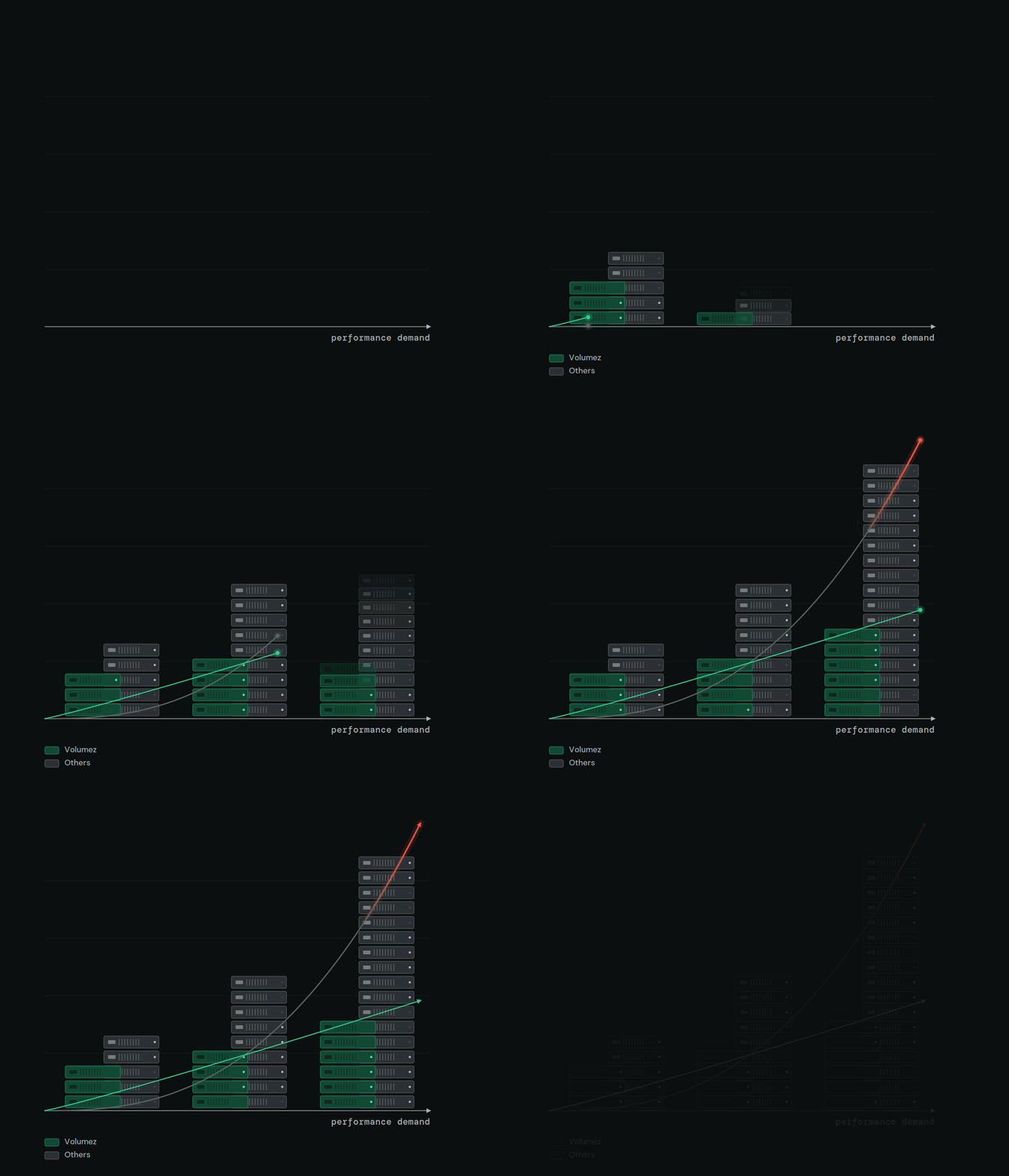
An animation: cost against performance demand. At each of three stages along the demand axis a stack of servers grows - the grey Others stack taller each time than the green Volumez stack in front of it, and by the third stage the grey stack is several times the height of the green one. A grey curve climbs away steeply and ends in red; a green Volumez line rises gently and almost straight, ending far below it.
the penalty

Cost, Complexity, Performance and Overall Experience

More hardware than the work requires

More nodes for performance and a separate system for every workload, each adding racks, power, cooling and licences while extracting less from every petabyte.

Inference state takes the long way to the GPU

A lookup, a software layer and a memory hop sit between the state and the GPU, and every extra step pushes time to first token up under load.

Fragmented data is delaying your AI readiness

Data sits in silos with its own copy and access path, so making it AI-ready means stitching, parsing, embedding and indexing it into yet more systems and pipelines.

GPUs recompute work you already paid for

Session state outgrows GPU memory and is evicted with nowhere fast enough to fetch it back, so the cluster rebuilds context it has already processed.

It's possible to reach superior performance on far fewer resources using an architecture built for performance and efficiency.

there's a better way

The Volumez way

Built from the bottom up on purpose.

Storage, data workloads, enterprise AI and inference on one underlying copy of the data. Fewer nodes doing more work, with the throughput, IOPS and concurrency the same infrastructure never delivered.
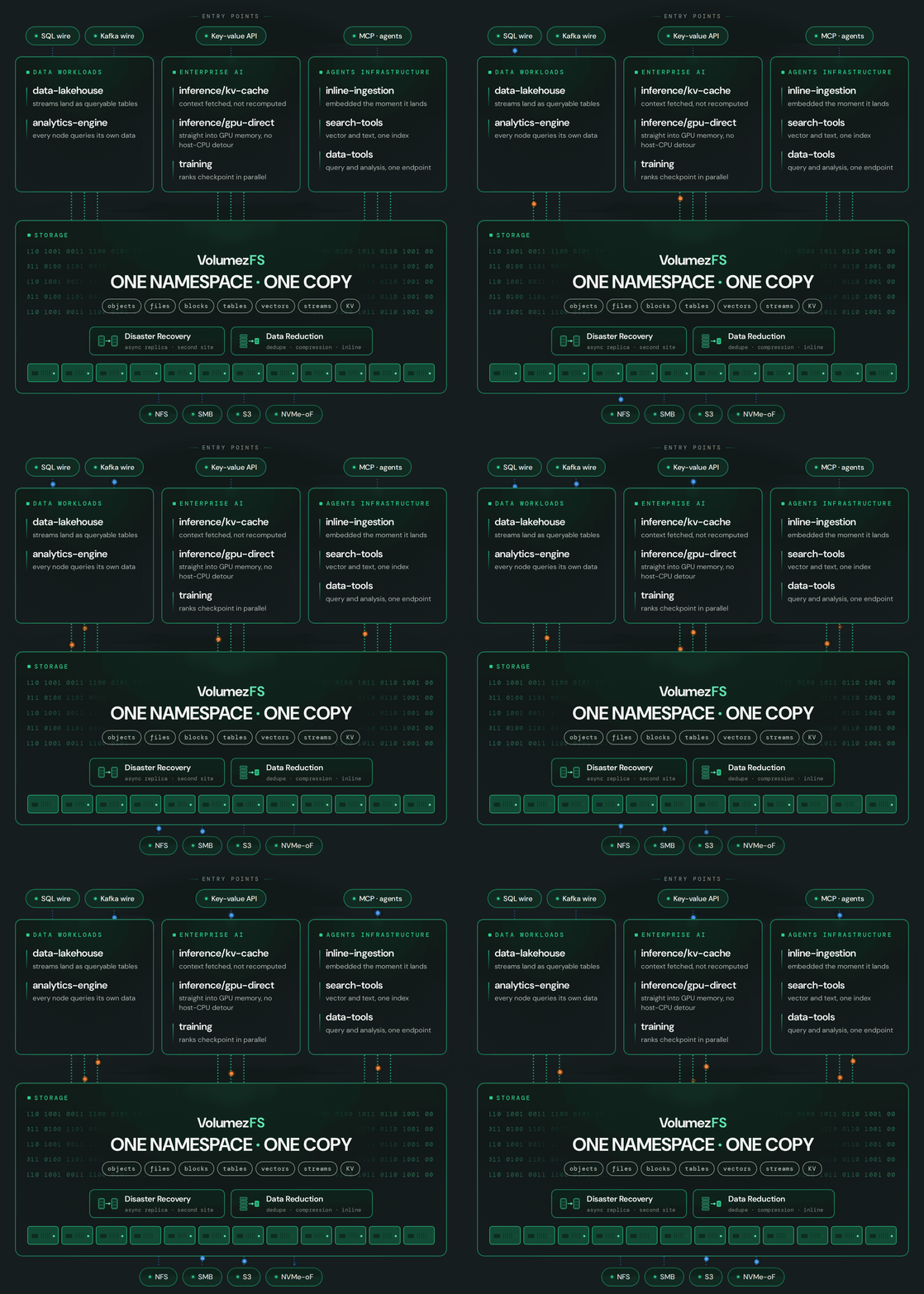
The Volumez platform map. Four entry points along the top - SQL wire, Kafka wire, a key-value API and MCP for agents - feed three panels. Data workloads holds data-lakehouse, where streams land as queryable tables, and analytics-engine, where every node queries its own data. Enterprise AI holds inference KV-cache, with context fetched rather than recomputed, inference GPU-direct, straight into GPU memory with no host-CPU detour, and training, where ranks checkpoint in parallel. Agents infrastructure holds inline ingestion, embedded the moment it lands, search tools for vector and text on one index, and data tools for query and analysis on one endpoint. Dotted lines run from all three into a storage layer labelled VolumezFS, reading ONE NAMESPACE / ONE COPY, holding objects, files, blocks, tables, vectors, streams and KV, with disaster recovery as an async replica to a second site and data reduction by inline dedupe and compression beside it, over a row of drives. NFS, SMB, S3 and NVMe-oF sit along the bottom as the protocols.
what makes it different

Four capabilities, one foundation

Each one removes a copy, a hop or a rebuild from the path between your data and the compute that needs it.

Data workloads

Compute where the data lives.

Heavy parallel processing – ETL, Spark, analytics – runs on the same nodes that hold the data. Nothing is copied out to a compute cluster, processed and shipped back. With less CPU spent on the I/O path, more compute is available, delivering more throughput from the same infrastructure.
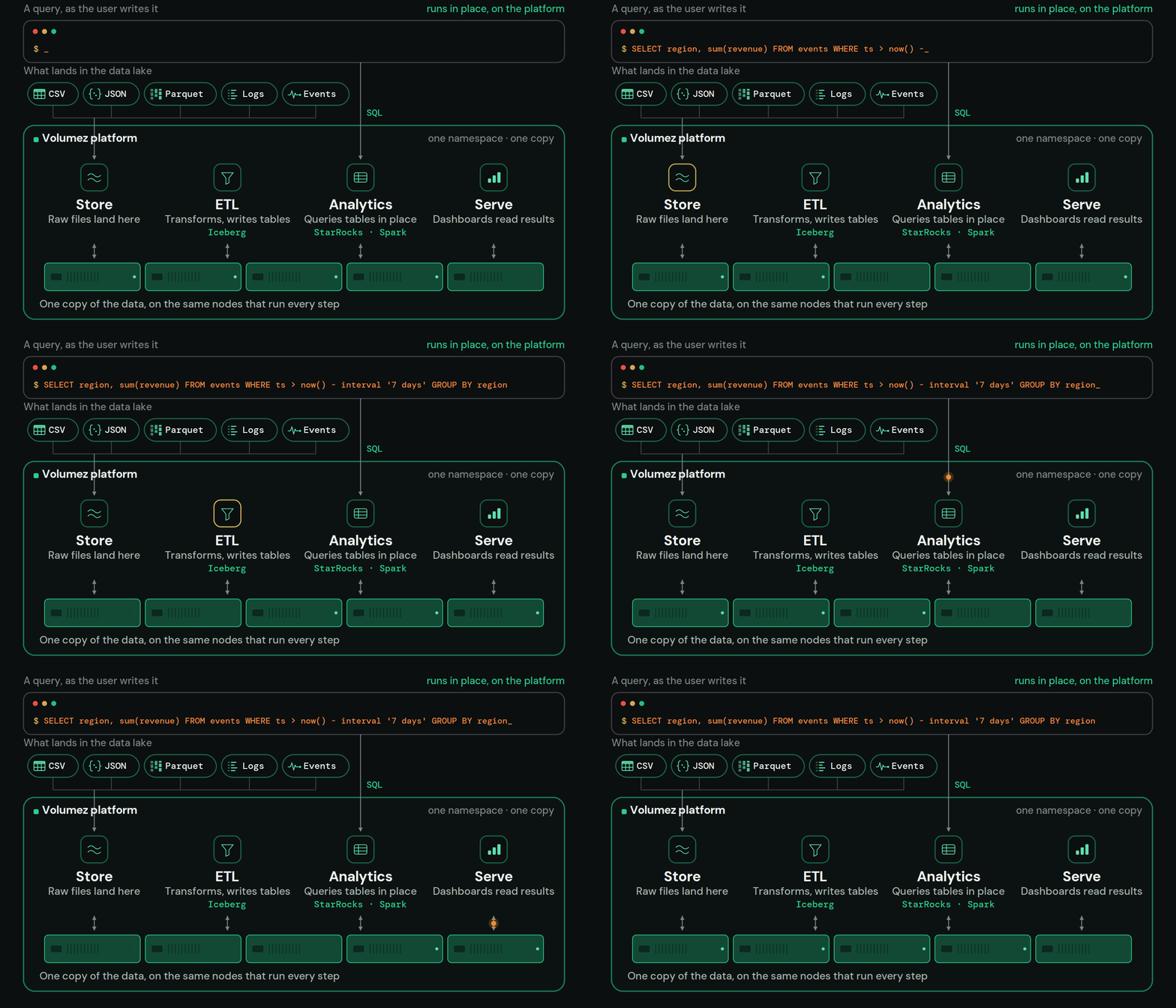
An animation: a query is typed as the user writes it and runs in place on the platform. CSV, JSON, Parquet, log and event files land in the data lake and feed the Volumez platform, one namespace on one copy, where four stages run on the same nodes – store, where raw files land; ETL, which transforms and writes tables with Iceberg; analytics, which queries those tables in place with StarRocks and Spark, reached directly over SQL; and serve, where dashboards read the results. Each stage sits over the same row of drives: one copy of the data, on the same nodes that run every step.

Enterprise AI

Reload instead of recompute.

Session state stays reachable across the entire GPU fleet – fetching beats redoing. Time to first token drops, long sessions stay as fast as short ones, and freed compute goes back to serving more users. GPU-agnostic: the same tier, whatever the fleet runs.
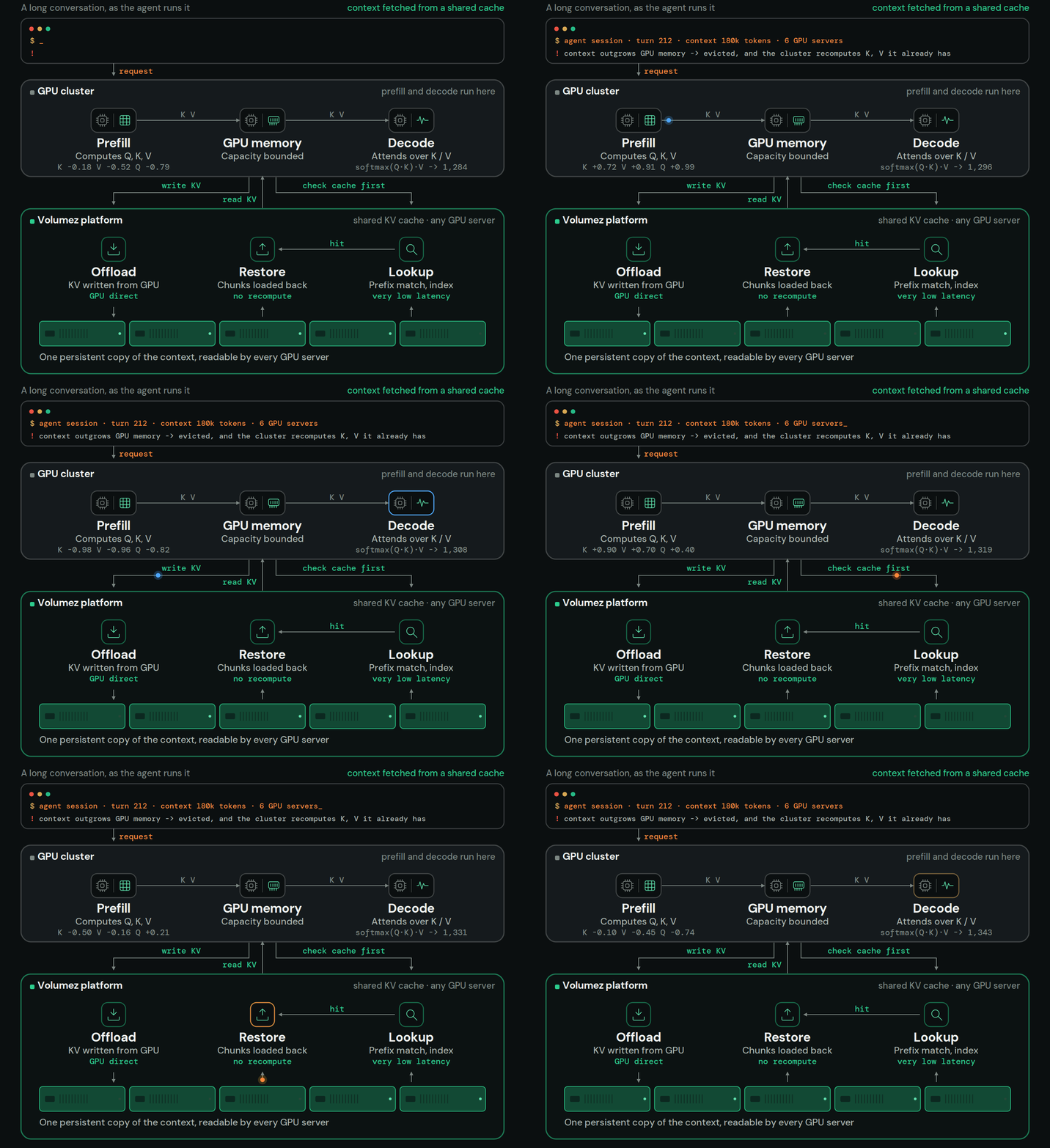
An animation: a long conversation runs as the agent writes it, and its context is fetched from a shared cache rather than recomputed. The request reaches a GPU cluster where prefill computes Q, K and V, GPU memory is the capacity bound, and decode attends over K and V. KV is written out to the Volumez platform and read back from it, and the cluster checks the cache first. On the platform – a shared KV cache readable by any GPU server – offload writes KV straight from the GPU, lookup does a prefix match on an index at very low latency, and on a hit restore loads the chunks back with no recompute. Underneath, one persistent copy of the context on a row of drives, readable by every GPU server.

Agents infrastructure

Agent-ready the day the data lands.

Ingestion, indexing and vector search happen as data arrives – kept hot, queryable by whatever asks. The index lives with the data itself, so nothing needs a second system and nothing falls out of sync.
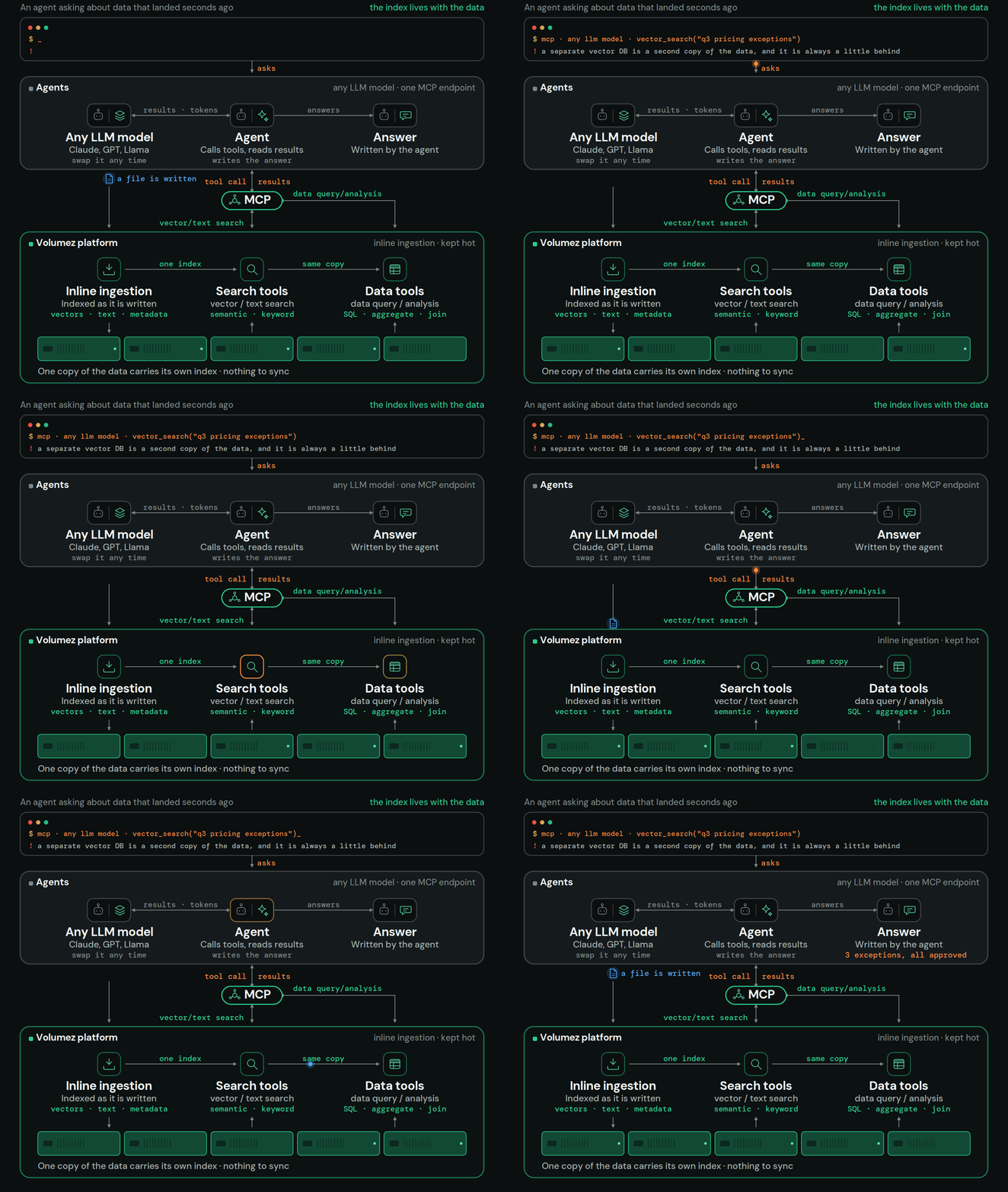
An animation: an agent asks about data that landed seconds ago, and the index lives with the data. Any LLM model – Claude, GPT or Llama, swappable at any time – backs an agent that calls tools, reads results and writes the answer, all through one MCP endpoint. A file is written into the Volumez platform, where ingestion is inline and the data is kept hot: it is indexed as it is written into vectors, text and metadata, search tools serve semantic and keyword queries over that one index, and data tools answer SQL, aggregate and join queries on the same copy. Underneath, a row of drives: one copy of the data carries its own index, with nothing to sync.

Storage & infrastructure

Placement computed, not searched.

No metadata tier and no central lookup for data placement – where data lives is a path equation. That removes a scaling bottleneck: throughput and IOPS scale linearly with nodes, latency stays flat as clients grow, and the same performance target needs less infrastructure.
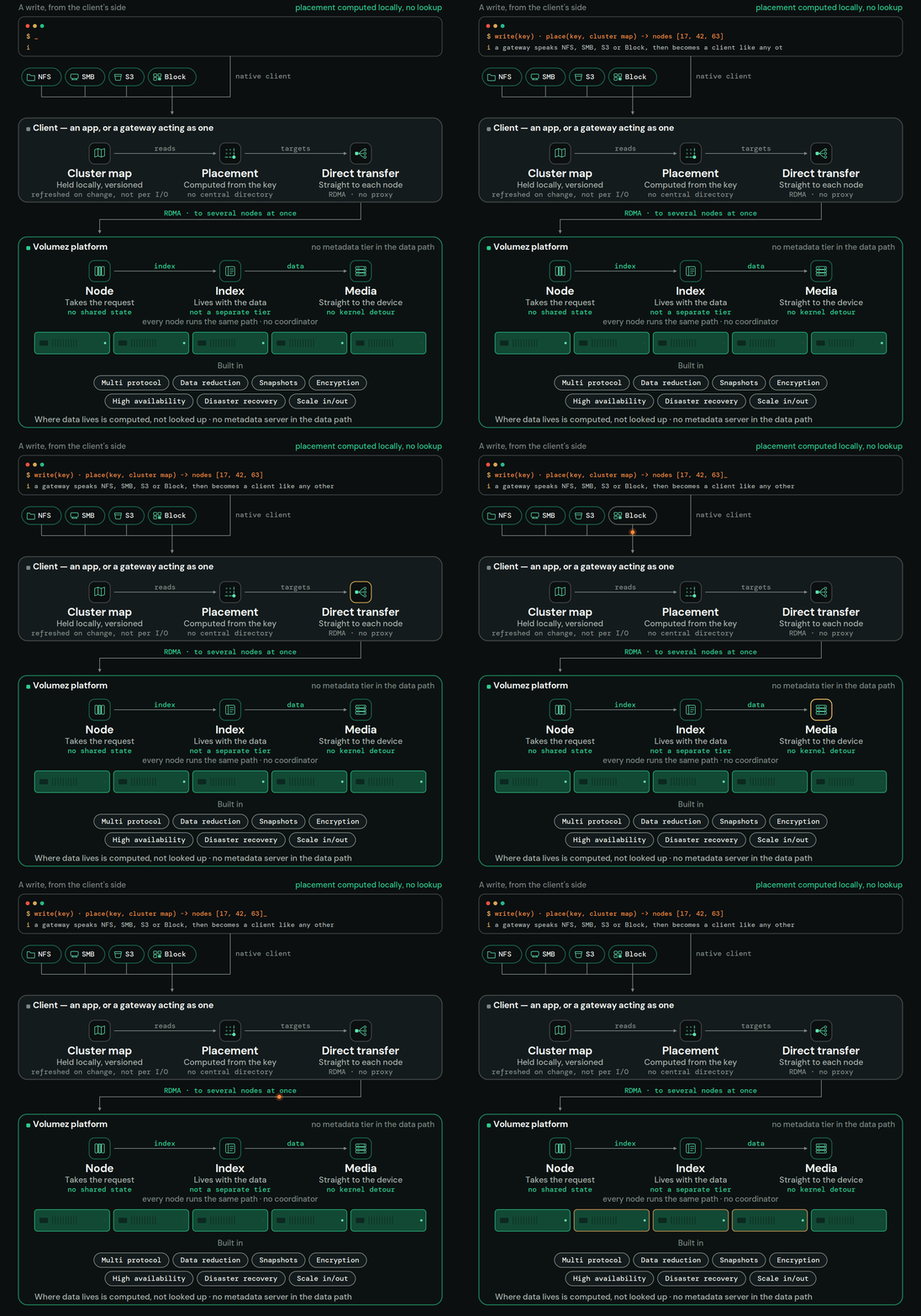
An animation: a write, seen from the client's side, with placement computed locally and no lookup. NFS, SMB, S3 and block all arrive through the same native client – an application, or a gateway acting as one – which reads a cluster map it holds locally and refreshes only on change rather than per I/O, computes placement from the key with no central directory, and transfers straight to each node over RDMA with no proxy, to several nodes at once. On the Volumez platform there is no metadata tier in the data path: a node takes the request with no shared state, the index lives with the data rather than in a separate tier, and media is written straight to the device with no kernel detour – every node runs the same path, with no coordinator. Multi protocol, data reduction, snapshots, encryption, high availability, disaster recovery and scale in/out are built in. Where data lives is computed, not looked up.
who it's for

Enterprise AI, GPU Clouds, HPC…

Teams whose economics are set by how well their infrastructure keeps expensive compute busy.

gpu clouds

GPU cloud providers

Sell more GPU-hours from the same fleet. A shared KV-cache tier and a GPU Direct path keep accelerators fed, and one storage layer serves every tenant workload instead of a stack per service.

enterprise ai

Enterprise AI platform teams

Run training, inference, analytics and retrieval on one copy of the data, behind the protocols your estate already speaks – no separate system per workload, no nightly pipeline to keep in sync.

hpc

HPC and data-intensive research

HPC-grade throughput and concurrency on commodity nodes, with linear scaling as nodes are added and flat latency as client counts grow.

One foundation for data workloads, agents, inference, retrieval and vector search – all operating on the same copy of your data.